Digital Photography

In one of the lessons in the first week we learnt about digital photography. Aperture is the size of the hole in the lens.This is where the light goes through.

Shutter speed is how long the camera is being exposed to the light.

ISO tells you how sensitive your camera sensor is.

Exposer triangle is where all three work together and if one changes the other two should change as well.
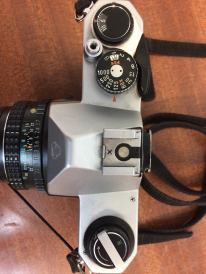
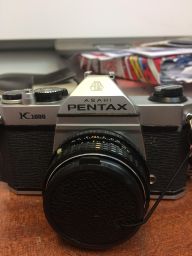
Pentax camera

On Wednesday we learnt about a Pentax camera and all its features.The aperture is the dial which is on the lens nearest to the body of the camera.The shutter speed is the dial on the  top of the camera.The ISO is also on this dial but to change the ISO you lift the dial and twist it.Once we had learnt about the features we then loaded the film.To do this on the left side of the top of the camera there is a dial which has a silver lever on it.The first thing you do is slowly pull on the lever and the back of the camera will open.You then take your film out its box and place it in the camera.After that pull the end part of the film and gently place it in the largest rotor which has a slit in it.Finally you close the back out of the camera and pull the lever 3 times.unnamed-1.jpg

Once the camera was set up we went out and started to take pictures.To take a photo you pull the lever on the right side of the camera and press the shutter button.

unnamed.jpg

Pictograms

When we were creating pictograms we went in the darkroom to use the enlarger.The first thing we did was collect objects.We then placed them on light sensitive paper and turned on the enlarger.Before pressing the timer I set it to 6 seconds.Once the light went off I placed it in the developer for 30 seconds .After it was placed in the stop bath for a minute.Then I placed it in the fixer and then water for 5 minutes.I repeated this process three times but changed the time.For the second one I changed the time to 4 seconds and the third one I kept the same but used some different things.On the last one I changed it to two seconds.

Justin Quinnell

Justin Quinnell is a pinhole photographer.He places his camera in his mouth to create his photos.I like his photos as they are unusual.Justin Quinnell has been doing pinhole photography for over 20 years.After we researched Justin we then went down to the darkroom to create our pinhole images.When doing pinhole photography you would need to make a pinhole camera.To do this you would need a small box which doesn’t allow any light on to it.Once you have your camera you must make a small hole in the front.When taking taking a photo you must cover the hole until you want to take a photo and count to 20 then cover the hole until you are back in the darkroom.Each time I changed the time as the first image nothing appeared.

Chemigrams research

A chemigram is a image which is created in a darkroom by using chemicals and light sensitive paper. They were invented by Pierre Cordier in the 1950s .Whilst researching about chemigrams I found a fine art photographer called Chloe Mccarrick.Her studio is in London where where she creates unique prints and presents.Her work includes chemigrams.

We learnt how to create our own.The first thing we did was create a chemigram by using our hand.I started by placing my hand into the developer and then placing it on the paper for 30 seconds.I then placed the paper in the stop bath for 1 minute.Then I placed it in the fixer and then water both 5 minutes.I did this again but placed my hand in the fixer first and starting the process from the start.once I had done that we created chemigrams with leaves.